Describe the task
Record who uses the room, where their eyes and screens are located, operating hours, daylight and the atmosphere the design should support.
Lithonia Lighting Guide
This guide turns an early project brief into a practical sequence of lighting questions. It is not a substitute for a photometric calculation; it helps you decide which values, files and installation facts belong in that calculation.
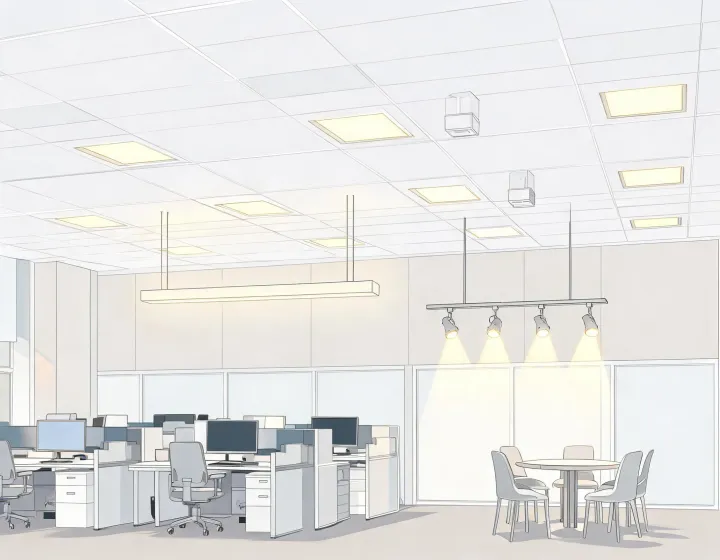
Record who uses the room, where their eyes and screens are located, operating hours, daylight and the atmosphere the design should support.
Check plenum depth, suspension points, track type, air-handling constraints, access panels and whether drivers can be serviced without opening finished construction.
Define target illuminance, luminous flux range, distribution, beam angle, CCT, CRI, UGR and control protocol before comparing decorative details.
High luminous efficacy can reduce connected load when the distribution still places useful light on task surfaces. It is especially relevant in long-hour spaces, but catalogue efficacy does not by itself predict room energy after controls or optical losses.
Low apparent brightness, controlled candela at critical angles, suitable CRI and comfortable vertical light may justify a different optical package. UGR is a calculated context value, not a universal fixture label, so room geometry and observer position matter.
Compare purchase cost with controls, installation labor, commissioning, replacement access and expected operating hours. An integrated luminaire may simplify appearance and thermal management, while a serviceable driver can reduce future disruption. Neither architecture is universally preferable.
Send the room type, plan status, mounting conditions and any target specifications. We can identify the missing inputs and discuss a shortlist for further calculation and mock-up testing.