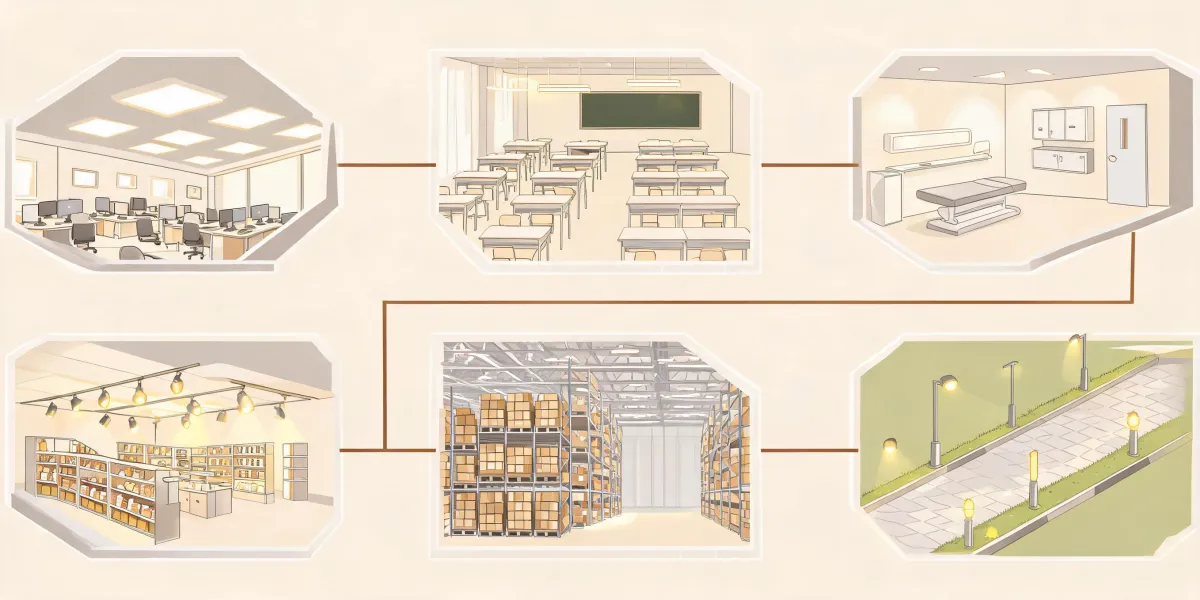
Work & Learning
Offices and classrooms benefit from restrained aperture brightness, useful vertical illumination, and control zones that follow daylight and occupancy. Review UGR, candela distribution, workstation orientation, board visibility, and sensor behavior together.
Typical evidence includes an IES-based calculation, luminaire spacing, CCT and CRI selection, and a commissioning sequence that defines timeouts and overrides.
Care & Hospitality
Healthcare environments may add cleaning, access, examination, and night-lighting considerations. Hospitality spaces often use layered ambient and accent light to establish a calm sequence between arrival, circulation, and guest rooms.
Color quality, low-end dimming, glare control, maintenance access, and emergency coordination deserve configuration-level confirmation.
Retail & Public Space
Retail combines circulation light with focused merchandise accents. Beam angle, aiming flexibility, TM-30 information, contrast, and track compatibility can be more revealing than a single efficacy number.
Public interiors also need durable mounting, understandable wayfinding, and service procedures that minimize disruption during open hours.
Industrial & Outdoor
Warehouse and exterior selections introduce mounting height, aisle geometry, ambient temperature, dirt, moisture, impact exposure, surge protection, BUG rating, and emergency requirements. IP and IK ratings should match the actual exposure rather than act as generic quality labels.
For high bays and area luminaires, check delivered flux, distribution, uniformity, controls coverage, and access for drivers or replaceable components.